There is a latin phrase, “veni, vidi, vici,” that remarks a deciding victory achieved in a short amount of time. The phrase itself translates to “I came, I saw, I conquered,” and is attributed to Julius Caesar.
Had I come to you today with such a victory, I might have that much to say regarding the Japanese Language Proficiency Test (JLPT) level N2. The truth is I have much more to say (plus I hate phrases with obnoxious comma splicing). I have passed the JLPT N2, but only by the narrowest of margins. Achieving exactly the minimum score possible to pass, that is, (90/180), I come with what I can only consider to be the exact measurement of effort, knowledge required to pass the second hardest test you can take for Japanese language certification.
It took two years to get my skills to the bare minimum required to pass. While that might sound like a short amount of time relatively to get to that level of Japanese, there is no finesse in how I passed. There is only tremendous effort, discipline, and a sort of Dunning-Kruger effect at the end of the day that brings the realization that I still might know nothing of the language.
Even so, I’m pretty psyched that I did get this far. For those interested, this blogpost will break down my methodology behind learning Japanese and tackling the JLPT N2. I will also dive into my personal testing experiences out in Los Angeles.

How I Studied
Full disclosure: a lot of my methods I used to study the language are an amalgamation of various other sources I have come across. Selling my methods as a novel strategy that cracks the JLPT code would be disingenuous to say the least, especially when I stand on the shoulders of giants, or in this case, miscellaneous blogs, vlogs, wikis, and persons scattered about the Internet. More knowledgeable readers who have done a handful of Google searches will find most of the material and methods listed here quite pedestrian, save for some ways in which I string together resources.
Below you will find how I prepared for the test and learned the language. The breakdown is divided by JLPT test categories in the order in which they appear on the test.
Kanji 漢字
If there was any one thing that really discourages people from trying to grasp Japanese, it’s the abundance of the borrowed Chinese characters, or kanji, that punctuates nearly every other character of the written language. The written language is composed of two syllabaries consisting of 48 characters that can be learned in about two weeks with repetition, but the same cannot be said of the dreaded Chex-Mix character set. While about 50,000 exist, 2136 are defined as standard use, “Joyo” and represent that which is used in modern Japanese, day-to-day (sadly this does not include some rather frequently occurring proper nouns). The JLPT N2 requires you to know at least 1000 of these.
In the past, the only approach to cementing these things in memory was simply brute force, dictation and repetition. Now that’s all well and fine if you are truly that dedicated (and perhaps a little masochistic), but more prudent people would discover pieces of literature, like Heisig’s Remembering the Kanji before undertaking such a thing. Both these pieces of literature offer mnemonic tools to help you remember the Kanji and associate with some familiar English term.
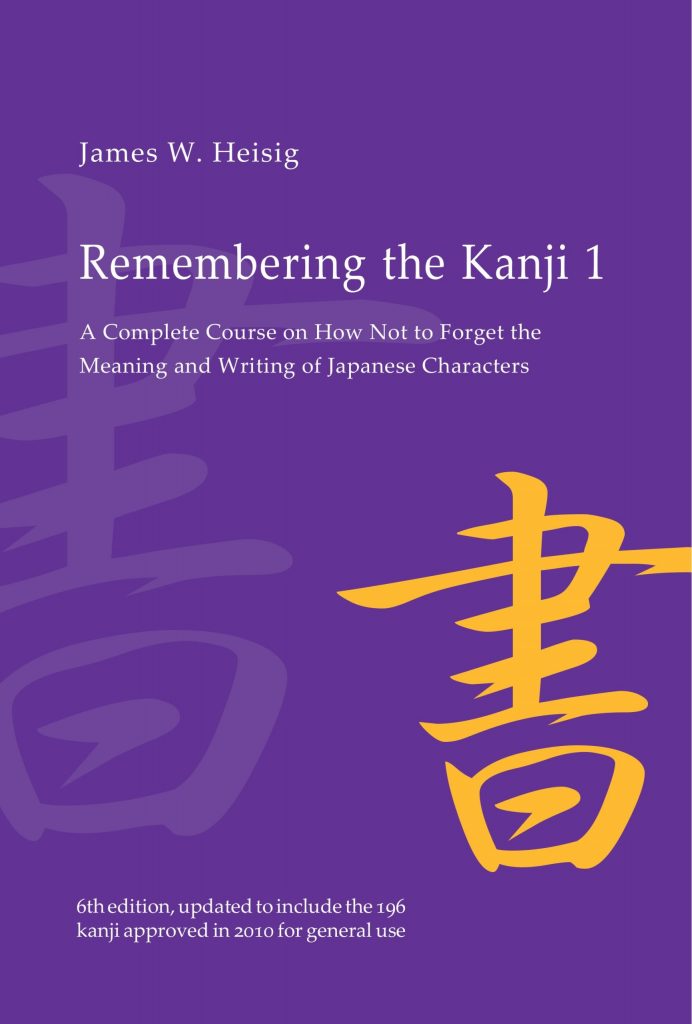
Heisig’s work is a household name for isolated kanji study, but for me, having followed the book from beginning to end, I cannot say it left that great of an impression on me. The thing I found most lacking about the material was the lack of any readings of the kanji (it only tells you roughly what ideas they represent in English, along with mnemonic, it is left up to you to figure out how they are actually read/spoken). This, together with a sort of diminishing return it had with more complex kanji in later lessons that could not be readily captured with a single English word, left the impression that is was less like a kanji learning authority and more like the sweaty Cliffnotes for passing a kanji test right before class. It did, however, teach me things I was not expecting to learn, like radicals, the more finer elements that make up kanji, and stroke order (but it gave up after a certain point in later lessons with strokes were numbering over twenty).
What I found to be the true ally in the fight against kanji was a more recently published work from Harvard academic Andrew Conning, Kanji Learner’s Course. This book I feel fills in the gaps of RTK, supplying multiple English words to help identify more complex kanji, identifying all possible ways a character can be read, and proper stroke order for every kanji. It even goes above and beyond in some aspects as well, offering example Japanese words that use a given kanji for to expand vocabulary, and documentation of possible pre-war forms for some characters. The book is exhaustive regarding kanji, and has a polish that RTK lacks.
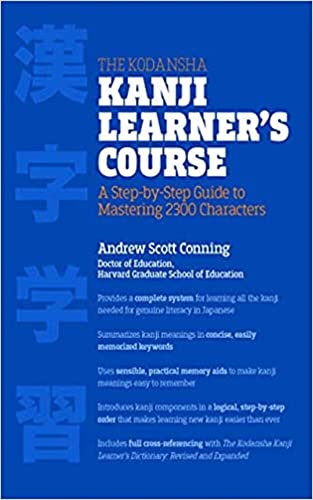
Using these materials, I slowly learned a large portion of the Joyo. I did this by writing down each character 3 times, along with its mnemonic story device and English keyword to keep it in memory. After every 20 or so characters, I reviewed by covering up the paper so that only triples of kanji were visible, and asked myself what English word it is attached to. As I continued to learn more Joyo, eventually I came to a point where exposure to written Japanese and osmosis filled in the gaps of what I was missing, so I ceased this exercise in favor of more vocabulary, grammar, etc.
While I do stress learning the Joyo, I think learning a few of the “proper noun” kanji, termed “Jinmeiyo,” may also be of great service. Kanji Learner’s Course includes such kanji along with the standard use.
Vocabulary 語彙
If there was any one thing that expanding my Japanese vocabulary “game-ified”, it was the flashcard program Anki, and its crowd-sourced flashcard decks for memorizing things.
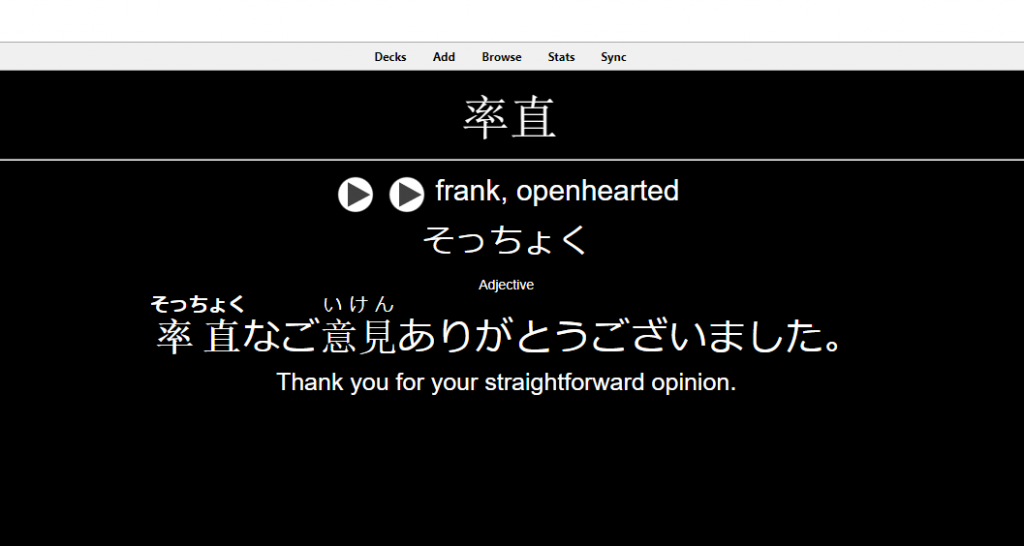
The app itself is a extremely well-made piece of software that is centered around the learning algorithm SpaceMemo-2, or SM-2 algorithm. In simple terms, Anki is measuring your ease of which you learn the cards, calculating the correct interval to test you against the card, and scheduling when to test your retention accordingly. Think of a typical flashcard deck you made in school, but with a deck shuffler that insures the best possible order for retention, along with the addition of images, audio files, and pretty markup text for additional study aide that can be customized accordingly.
The best part about this app is that it usually eliminates the boring part of flashcard decks: making them! The flashcard decks are shared between users using https://ankiweb.net where decks are uploaded, rated, and cultivated by users who do their part in sharing knowledge and growing the community. As long as someone else has already made a deck and supplied it online, there is no need to go through the trouble of making another.
My process of growing my vocabulary was as simple as downloaded the app for my PC, Linux, and Android devices, downloading a 6K optimized Japanese word deck, syncing it with the app and finding the odd 30 minutes or bathroom break to open up the app on my phone and begin grinding down cards. Over the course of roughly two years and many scholarly shits, I was able to learn nearly 6000 words, which was approximately what is required for passing the JLPT N2. My Anki stats are shown below.
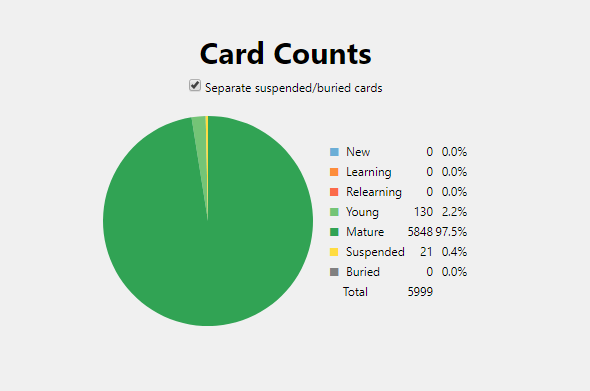
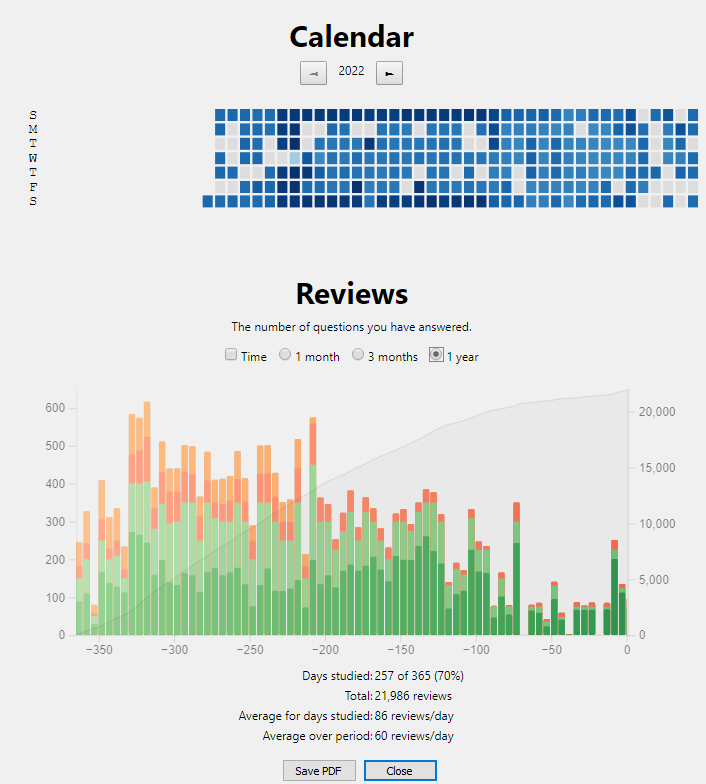
While the app’s name would imply that its sole purpose is to learn Japanese words (“Anki” is 暗記, meaning memorization), Anki can be used in any pursuit that requires one to memorize a large amount of content. There are decks on Ankiweb for learning everything from human anatomy and pharmaceutical terminology, to key bindings to software and chemical structures and formulas, plus a variety of different words characters across many languages. I would encourage all people, regardless of their interest in the Japanese language, to install this app based on this multi-faceted application alone.
Grammar 文法
Words and kanji are important, but often times the infrequent unknown character or word caught in the middle of a context well understood won’t completely murder your understanding of a sentence. Learning to fill in the blanks when coming across single nouns, verbs, adjectives is totally doable in Japanese, if not all languages to some extent.
What does prevent you from understanding written and spoken Japanese is its grammar, which is a terrifying beast that bears fangs of numerous verb conjugations, set phrases, and grammatical forms that exhaustively distinguish the speaker and listener’s class, gender, and formal/casual setting. A single change in a Japanese particle, like a 「は」 or 「で」, can completely change the meaning of the sentence. Failing to grasp any of it will likely result in a failing grade, likely due to dismal scores on not only grammar sections, but reading and listening as well. This goes beyond just test scores too. You will likely fail to apply your kanji and vocabulary in any meaningful way.
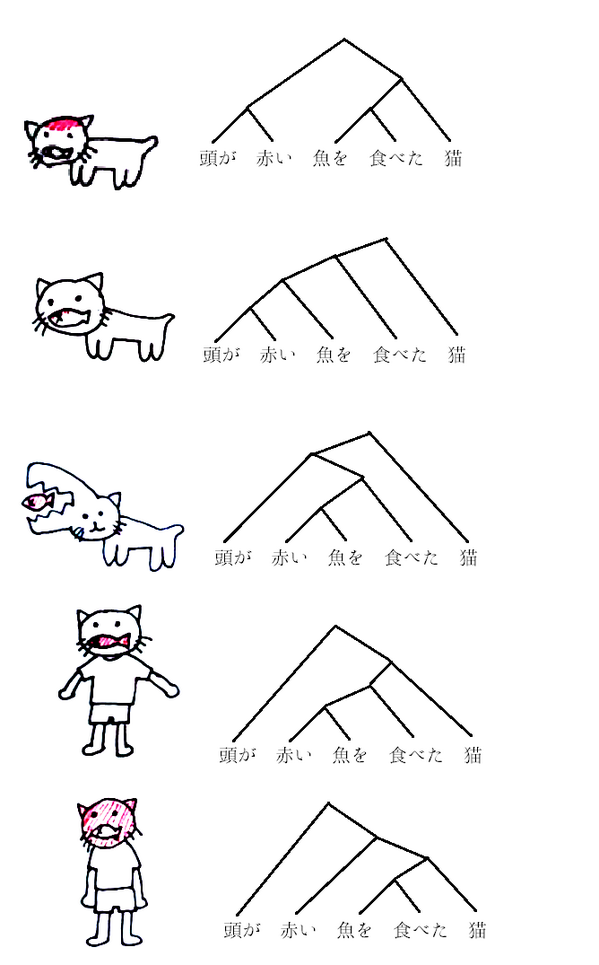
The reality I came to understand was this: you will open up boring, seemingly Necronomicon-sized books regarding grammar, and read through them until you have a better understanding of how the language works. It will not be fun, in fact it will be rather grueling. Most of the books, especially the Dictionary of Japanese Grammar tackle the subject in a very academic and obtuse way. These books will explain things in high level linguistic terms like genitives and nominalizers, almost as if the assumption is you are vying for a PhD. If you are anything like me, you will read and take notes on what you can understand and what you find truly helpful, and leave the more linguistic approaches to the ivory tower erudite.
I read a variety of books regarding the grammar. The first was Tae Kim’s Guide to Learning Japanese, which covers some bare bones basics of the grammar, including basic particles, counters, verb conjugation, subject-object-verb formation. Tae Kim gives a good foundational understanding of the grammar, (I especially appreciated his breakdown on conjugation of verbs) but latter chapters do tend to go all over the place, from keigo, to set expressions, to more practical applications of the grammar like making requests. After this book, I read most of the entries for both DOJG Basic and DOJG Intermediate. As previously mentioned, these books are pretty boring to read, but exhaustively list out grammatical structures, and all contexts where they might be used. After reading and taking notes where appropriate, I then went on to reading material and test preparation.
Reading/Listening 読解/聴解
I am grouping both of these sections up, as they really are the application of all the aforementioned sections, and thus speak to the ability to understand and comprehend Japanese. However, make no mistake-written Japanese can be different to that of the spoken variety. Large swaths of words and grammar are meant to be used exclusively in a written context and sound extremely out-of-place when used in conversation, and vice versa.
The good news is that there is no shortage of Japanese found online, written or spoken. The web is rife with content covering a variety of topics, with varying degrees of difficulty to read. You will figure out pretty soon what is manageable to listen to or read. Pick a piece of media that peaks interest, and start getting exposed to it from there. For me it was a combination of Beat Takeshi film, and Japan-exclusive Playstation titles that I played on emulators. (legally dubious, but no one will stop you from downloading a Japanese region Playstation BIOS and トキメキメモリアルー伝説の木の下で ROM image now are they?)

As I surf the web, there is one tool that I used that helped me digest the content from my browser. The extension Yomichan will enable you to hover over any Japanese text you find, analyze it and learn its meaning. It can be supplied with online dictionaries that can detect dialects, idiomatic phrases, and can even give audio samples and kanji breakdown. It also can be integrated with Anki, and allows you to build on to your flashcard deck from what you encounter in your browser.
If one was looking for an actual book of sorts to begin learning skills like listening an reading after learning enough grammar, words, and kanji, then my recommendation is An Integrated Approach to Learning Intermediate Japanese. This book is supplied with a CD containing very standard Japanese conversations for listening, along with written transcripts of those conversations for reading along. Each chapter is divided into daily contexts, like school and work, and cover various formalities and settings that really capture spoken Japanese well. In addition, there are also large essays written at a N2 level for reading that cover genuinely interesting topics I never even knew about, like Ranald MacDonald. In addition, there are review sections each chapter for vocabulary and grammar, just in case you need that extra review.
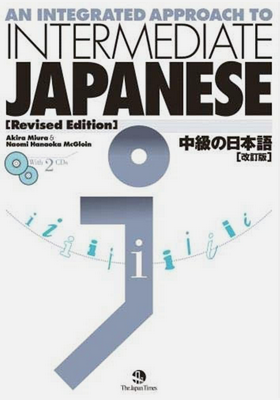
This book, in addition to the media I consumed were really the only tools I used to train myself for these sections, save for the test prep…
Test Prep
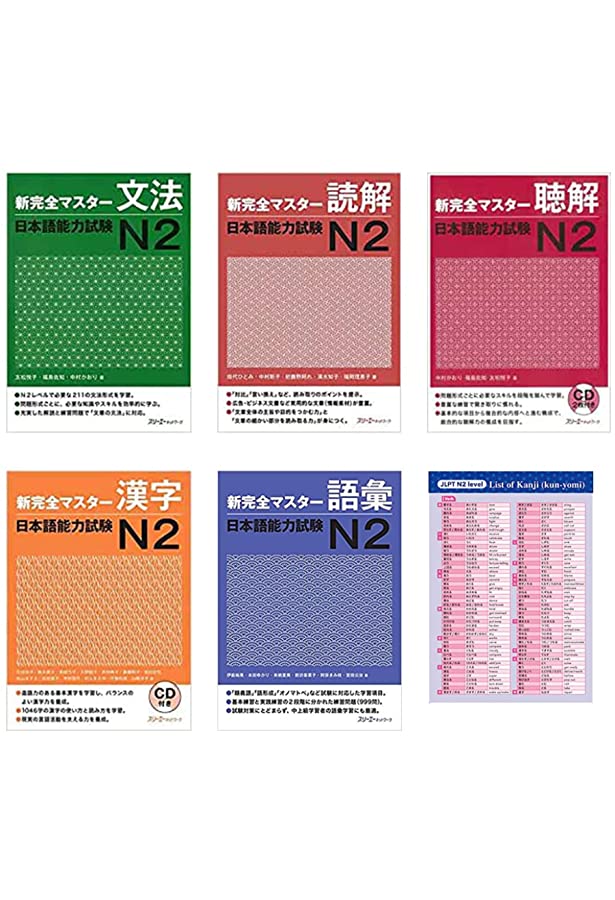
Knowing what questions will look like on the test is important. What I found was the best resource to acquaint myself with JLPT N2 questions was the Shin Kanzen Master N2 series of books. These cover each section of the test, and provide relevant review along with sample problems representative of what will be on the test. Excellent resource for anyone tackling the N2.
What the Test was Actually Like
My testing site was located in LA, at California State University. The building was crowded and filled to the brim with examinees and proctors, all fitted into a university that seemed to be built back in the Cold War era. For those fellow aggies reading this, think Blocker building.
I thought myself prepared for all that the test would throw at me, but I was gravely mistaken. My fellow examinees were definitely the strangest of people I have seen in a long time. I was expecting a large amount of nerds and weebs, but what I wasn’t expecting was this: A. the legit hairiest guy I have ever seen in my life, with angel wings of back hair sprouting forth from his wife beater like a demented angel, and B. a man so old he could have propped up the flag on Iwo Jima himself. In fact, during the listening portion of the test, he requested that the volume be turned up, as he was having trouble hearing from the front desk of the classroom. This sounds rich coming from a guy as weird as me, but expect to see quite a few characters if you do plan to take the JLPT yourself, specifically those that know kanji before their arid BO.
Be ready for the listening portion, and pray that the proctors were given proper speakers beforehand. If you have trouble, feign deafness, or wait for the designated geriatric of the classroom to request for greater volume.
When it came to test order, I feel like it may be worthwhile to do things a bit out of order. I was not able to complete the last 5 questions of the reading section, and ended up guessing quite a bit. It may be beneficial to do this section first, as fatigue can set in after the grammar and vocabulary sections quite easily.
For the listening portion, I found that there are some instances where you must take into account the station of the people conversing. In particular, there was a multiple choice question regarding a conversation in an office setting with a boss and his subordinate, where you needed to answer what would be the follow up response the subordinate would make. Two of the responses were fitting, but one used correct humble conjugation for verbs that was representative of how a subordinate would speak to his boss. Keigo is infinitely important at times to answer some of the questions correctly on the listening section.
Results & Final Thoughts
In all seriousness, I truly believed that I failed this test. I felt confident about my kanji and vocabulary performance, but the grammar, reading and listening sections left me distraught. This made the 6 hour drive back to Phoenix excruciating. I resigned myself to the idea that I paid $200 and drove all the way out to LA and back to fail a test. To say that I was pleasantly surprised would be the understatement of the century.
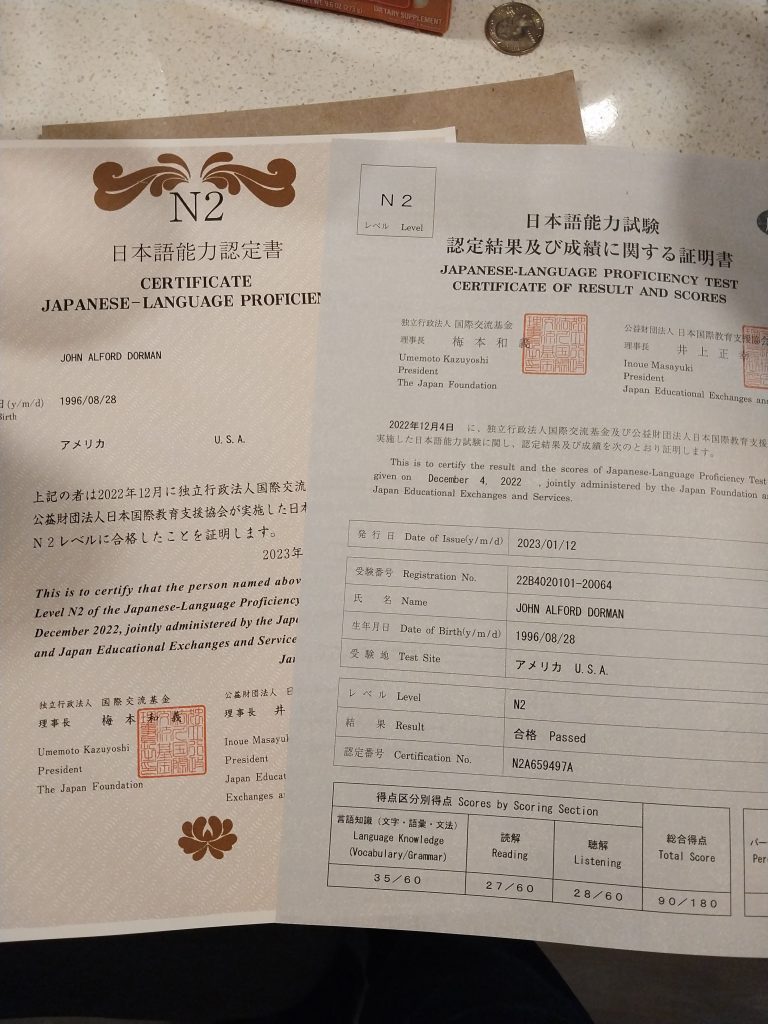
Minimum passing score aside (90/180), I feel pretty accomplished. Two years is a short time to pass the N2 I feel, but I managed. If anyting, my methodology, my discipline, and my efforts can serve as a damn near exact metric of what it takes to pass the N2. But the reality is, what N2 considers the bare minimum effort required to pass, for me, was my maximum.
For those reading this that seek to conquer the N2, I wish you luck in your endeavors, and hope that some of my approaches may lead to your success.
Leave a Reply